
This beauty smoothie bowl recipe surprised me when I first tried it. It has a sublime, smooth consistency of whipped mango mousse. This recipe is from The Healthy Skin Kitchen, for people with eczema and skin inflammation.
Smoothie bowls are popular at the moment so we wanted to create an eczema-friendly smoothie bowl recipe for people with chemical sensitivities. This one is low in salicylates and free of dairy, gluten and caffeine.
The health benefits of papaya
People with leaky gut may benefit from adding papaya into their diet as papaya is a natural digestive aid that promotes healthy gut flora. Papaya is slightly anti-inflammatory and can help to prevent constipation.
The papaya in this recipe provides 100% of your body’s daily vitamin C needs (about 85 mg of vitamin C per 140 grams), plus lycopene, folate, beta-carotene, magnesium and vitamin B5 for healthy skin.
The health benefits of flaxseed oil
Flaxseeds are rich in omega-3 which helps to hydrate your skin and reduce skin inflammation. A research study on flaxseed oil found that as little as half a teaspoon of flaxseed oil can help to hydrate and smooth dry, rough skin (see below for supporting research).
If you are sensitive to chia seeds (they are in the mint family and some people adversely react to them), leave them out or swap them for flaxseeds.
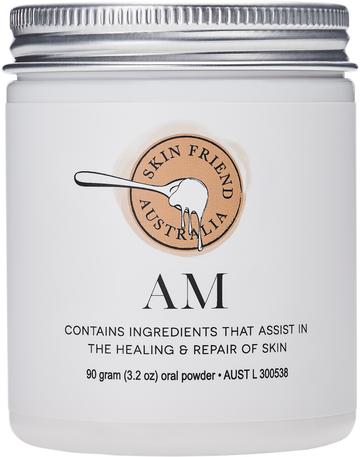
Skin Friend AM
Skin Friend AM is added as an anti-inflammatory vitamin boost, with skin-repairing zinc, magnesium, biotin, B vitamins, vitamin C, molybdenum and glycine for collagen formation, and it helps the smoothie to have a lovely mousse consistency. It is an optional ingredient.
Natural prebiotics
Banana is a natural prebiotic as it’s rich in soluble fibre called inulin. Prebiotics help to recolonise healthy gut flora in the digestive tract and boost the absorption of calcium and magnesium. People with digestive issues can benefit from adding natural prebiotic foods into their diet.
Papaya Beauty Smoothie Bowl Recipe
Serves 1, preparation time 5 minutes (pre-freeze papaya overnight)
Tip: the cashews must be soaked to enable a smooth consistency. If you are allergic to any type of nuts, leave out the cashews and use quality rice milk instead.
Rice malt syrup (also known as rice syrup in the US) is a fructose-free sweetener so it is naturally less sweet. So if you have a sweet-tooth and want this recipe to be sweeter use real maple syrup instead of rice syrup.
Ingredients
- ½ medium papaya, skin removed, sliced and pre-frozen
- ¼ cup soaked raw cashews (must be soaked 2-4 hours)
- ½ cup cashew nut milk or rice milk (tip: check your rice milk is free of antioxidant/BHA - it's often hidden in sunflower oil and not listed on the pack!)
- ½ teaspoon flaxseed oil (I use Melrose organic flaxseed oil, small jar only to use up quickly to ensure freshness; keep it refrigerated)
- 1 scoop Skin Friend AM (optional)
- 1 – 2 tablespoons rice malt syrup (rice syrup) or real maple syrup
Method
Place all of the ingredients into a high-powered blender (not including toppings) and blend on high until smooth. Serve in a bowl and top with chia seeds, fruit and crushed cashews. You can consume it immediately or allow time for it to set by placing it in the refrigerator for at least 20 minutes or until it has set.
Recipe by Karen Fischer and Katie Layland. Photos by Karen Fischer.
Click here to purchase The Healthy Skin Kitchen

Products
At Eczema Life, we recommend nutritionist Karen Fischer's program and book, The Eczema Detox, along with additive-free supplements for skin health and wellbeing. Click on the images to view more details:

Supporting research
Wall, M.M., 2006. Ascorbic acid, vitamin A, and mineral composition of banana (Musa sp.) and papaya (Carica papaya) cultivars grown in Hawaii. Journal of Food Composition and Analysis, 19(5), pp.434-445.
Sancho, L.E.G.G., Yahia, E.M. and González-Aguilar, G.A., 2011. Identification and quantification of phenols, carotenoids, and vitamin C from papaya (Carica papaya L., cv. Maradol) fruit determined by HPLC-DAD-MS/MS-ESI. Food Research International, 44(5), pp.1284-1291.
Neukam, K., De Spirt, S., Stahl, W., Bejot, M., Maurette, J.M., Tronnier, H. and Heinrich, U., 2011. Supplementation of flaxseed oil diminishes skin sensitivity and improves skin barrier function and condition. Skin pharmacology and physiology, 24(2), pp.67-74.
De Spirt, S., Stahl, W., Tronnier, H., Sies, H., Bejot, M., Maurette, J.M. and Heinrich, U., 2008. Intervention with flaxseed and borage oil supplements modulates skin condition in women. British Journal of Nutrition, 101(3), pp.440-445.
Slavin, J., 2013. Fiber and prebiotics: mechanisms and health benefits. Nutrients, 5(4), pp.1417-1435.
Kolida, S. and Gibson, G.R., 2007. Prebiotic capacity of inulin-type fructans. The Journal of nutrition, 137(11), pp.2503S-2506S.
Roberfroid, M.B., 2007. Inulin-type fructans: functional food ingredients. The Journal of nutrition, 137(11), pp.2493S-2502S.
Coudray, C., Tressol, J.C., Gueux, E. and Rayssiguier, Y., 2003. Effects of inulin-type fructans of different chain length and type of branching on intestinal absorption and balance of calcium and magnesium in rats. European journal of nutrition, 42(2), pp.91-98.


